White Moons, Blue Sunsets
Atmospheric composition and color

White Sun, White Moon
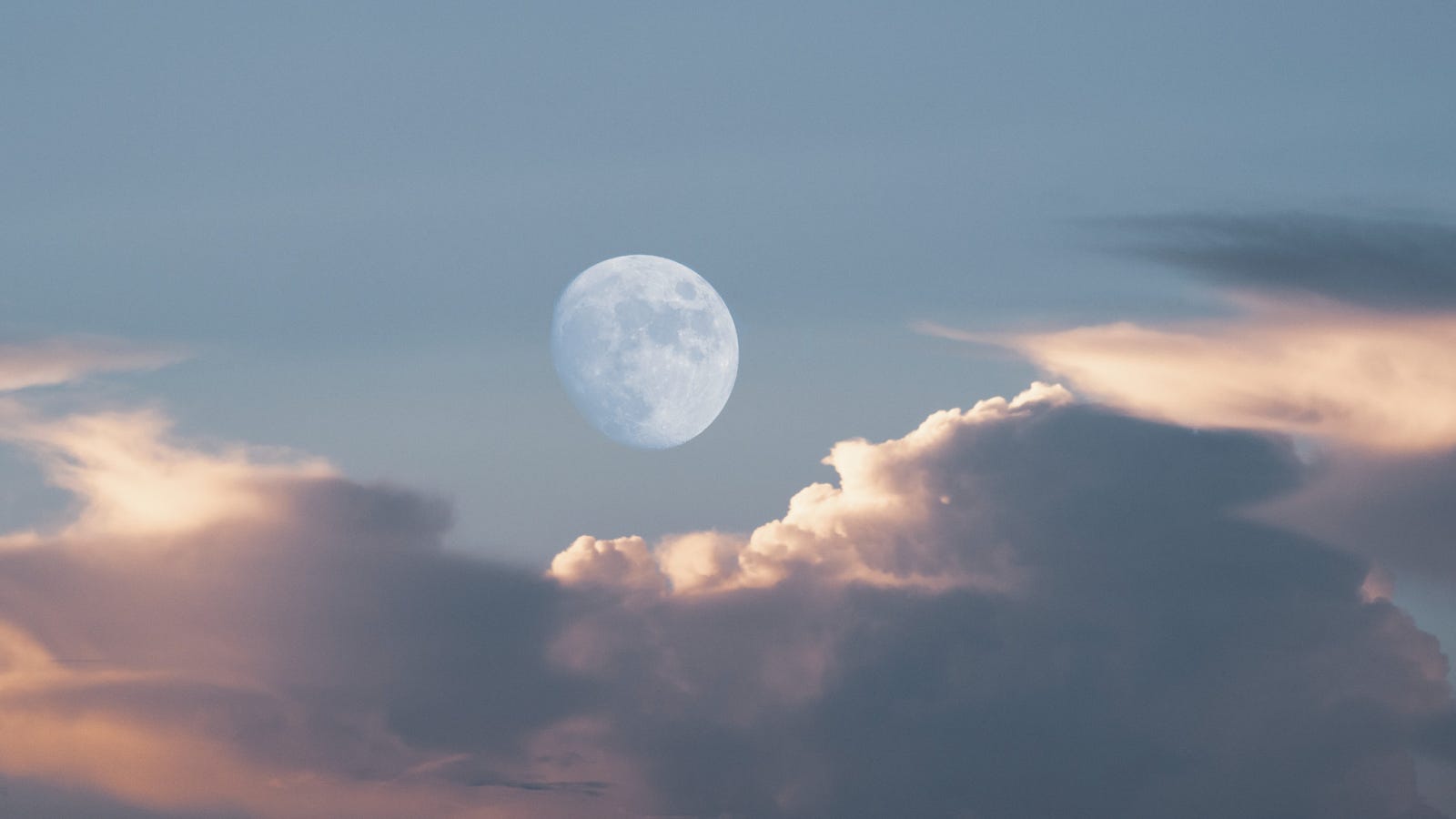
Having a toddler makes you ask a lot of basic questions. Lately, we’ve noticed that the Sun is always yellow/orange and the Moon is always white in the books we read… “Why?”… This is a tough one. The Moon reflects the Sun’s light, so shouldn’t they be the same color?
I haven’t found a simple explanation. The solar spectrum is pretty flat in the visible, peaking weakly in greenish wavelengths. So maybe the Sun is white, but it appears yellow to us because Rayleigh scattering by atmospheric gases preferentially scatters short (blue) wavelengths, leaving yellower-looking light? But sometimes when we’re going home from daycare we see a white Moon even when it’s daytime.
Another possibility is the colors come from how we perceive bright objects against different backgrounds (blue sky in the day, black sky at night). But again, we see a white Moon against a blue sky in the daytime. So what’s going on?
(Credit: Live Science)
After spending more time on this question, I think the strange thing is that we perceive the Sun as yellow. It is white, but several effects combine to make us associate sunshine with the color yellow:
The Sun is too bright to look at directly for most of the day, so we infer its color by looking at sunrise and sunset. At these times, sunlight takes a longer path through the atmosphere, leading to even more scattering and yellower light. The Moon also appears yellow when it rises and sets.
The Sun is too bright to look at directly for most of the day. Instead, we infer its color from the light around it, which appears yellowish. By contrast, because the Moon isn’t so bright, we are able to pick it out against the blue background. Looking carefully, I can convince myself it has a yellowish halo.
The Bezold-Brücke effect says that as intensity increases, the apparent hue of a stimulus shifts towards blue if its dominant wavelength is <500 nm or yellow if its dominant wavelength is >500 nm. The peak of the solar spectrum is right around 500 nm, but Rayleigh scattering might push the peak above 500 nm in the daytime, making us perceive a yellower Sun. The Moon isn’t bright enough for this to matter. This is more speculative and I’m not sure how much it actually contributes. There may be other reasons related to how we perceive light of different intensities.
Together, these effects give us the sense that the Sun is yellow/orange, which then gets reinforced through books and drawings. But the Sun’s true color is closer to how we observe the Moon.
Blue Sunsets
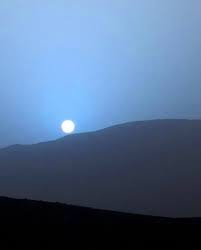
So a big part of why we think of the Sun as yellow is because of how it looks when it rises and sets. But sunsets aren’t always yellow. Air pollution can shift sunsets toward deeper oranges and reds. And I learned recently that Martian sunsets can be blue:
(Credit: NASA)
These blue sunsets are the inverse of our yellow sunsets. On Earth light is mostly scattered by atmospheric gases like nitrogen and oxygen which are much smaller than the wavelengths of visible light. This leads to Rayleigh scattering, with smaller wavelengths (bluer light) preferentially scattered. During sunrises and sunsets the light takes a longer path, with so much scattering that we don’t see the blue light anymore, leaving our yellow Sun.
Mars’ atmosphere is too thin for there to be much Rayleigh scattering (about 100x less dense than our atmosphere). Instead, light mostly interacts with iron-rich dust particles a few micrometers in diameter. These particles are comparable in size to visible wavelengths, putting them in the Mie scattering regime.
The dust has two effects (see this great paper for a full discussion). First, the iron oxide in the dust (hematite) preferentially absorbs blue light, while the typical particle sizes on Mars scatter red light more effectively. The net result is that more red gets removed from the sunlight than blue. If you look directly at the Sun it appears bluish, especially at sunset, when light takes a longer path through the dusty atmosphere.
Second, Mie scattering tends to be forward-scattering – light continues in roughly the same direction after scattering. This forward-scattering peak is narrower for shorter wavelengths, so blue light gets concentrated into a tight cone around the Sun while red is spread more broadly. At sunset, when the light takes a long path through the atmosphere and there’s more scattering, the concentrated blue wins out over the more diffuse red.
The first effect makes the Sun itself seem blue, while the second effect gives the Sun a blue halo.
You might wonder whether we ever get blue sunsets on Earth. In general, our atmosphere is thick enough that Rayleigh scattering removes most blue light – there’s nothing left for the dust to forward-scatter. But sometimes there’s enough aerosol for us to get blue sunsets. After the 1883 Krakatoa eruption sunsets were blue and green for several weeks.
So on Earth we have blue skies and yellow sunsets because light is mostly scattered by atmospheric gases, while on Mars the sky is butterscotch and sunsets are blue because light is absorbed and scattered
by iron-rich dust. Maybe Martians think of the Sun as blue?